
Oxford & Twill Shirt Manufacturing in Turkey: A Buyer's Guide
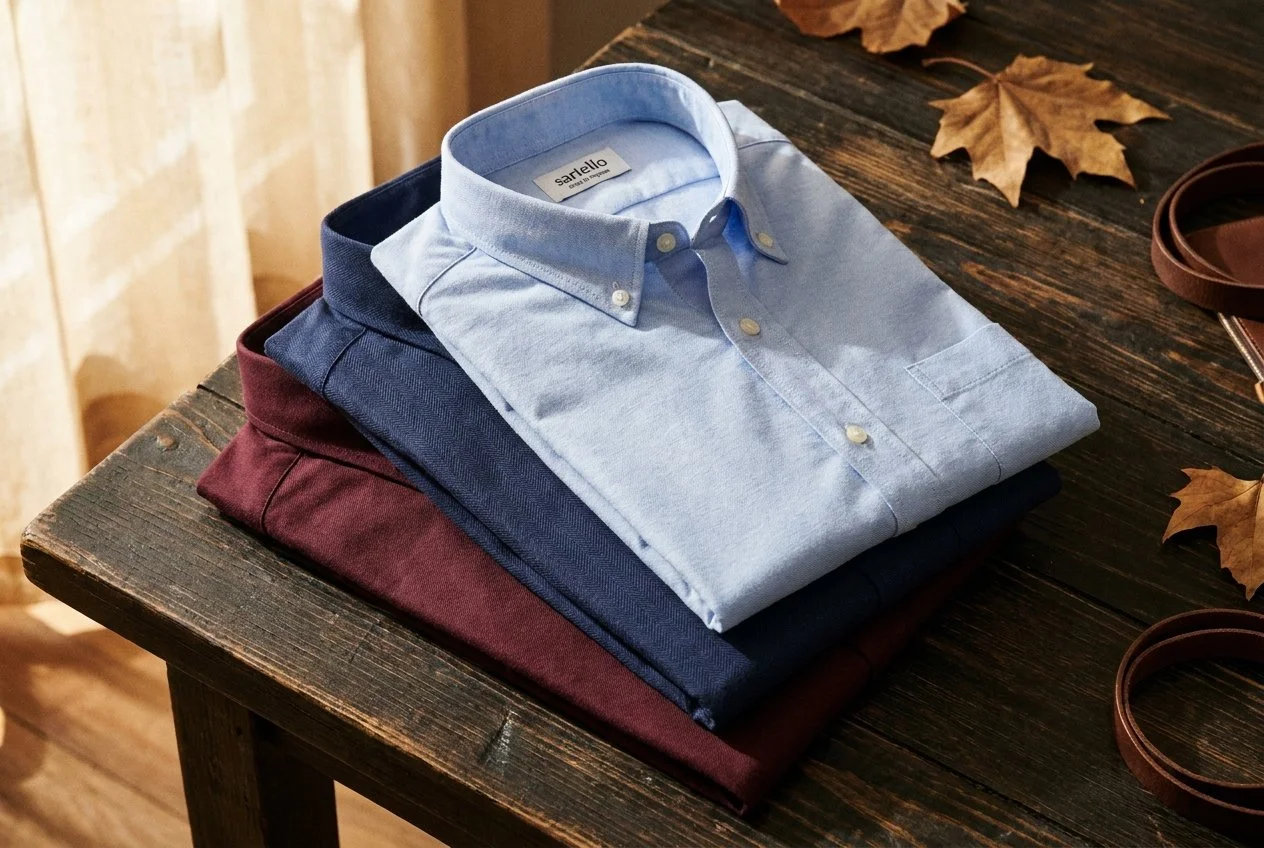
Oxford and Twill Shirts
Poplin gets most of the attention in shirt manufacturing conversations. But for brands building a well-rounded collection — or targeting the business casual and smart casual segments — Oxford and twill are where the real volume often sits. They're the fabrics that carry a shirt collection through autumn and winter, that perform in markets where a stiff poplin dress shirt is too formal, and that hold up better through repeated wear and washing.
Turkey produces both at a high level. Here's what you need to know before placing an order.
Oxford vs. Twill: Understanding the Difference
They're often mentioned in the same breath, but Oxford and twill are structurally different fabrics with different end-use positioning.
Oxford is a basket-weave fabric — two warp yarns interlace with one weft yarn in a pattern that creates a soft, slightly textured surface. It has a casual warmth to it that poplin doesn't. Standard Oxford is the fabric of the classic button-down collar shirt; pinpoint Oxford uses finer yarns and a tighter weave, bringing it closer to dress shirt territory without losing its characteristic softness. Royal Oxford adds a subtle sheen and is firmly in the premium tier.
Twill is a diagonal-weave fabric where the interlacing pattern produces visible diagonal lines on the surface. It's denser than poplin, has more drape, and is more forgiving of wrinkles — which is why it's popular for shirts worn through long working days. Herringbone is a twill variation with a mirrored diagonal pattern. Both are heavier than poplin and better suited to cooler weather.
For brand positioning: Oxford reads as smart casual to business casual. Twill reads as business formal to premium casual depending on weight and construction. Neither is interchangeable with poplin, and brands that try to use them as direct substitutes often end up with a product that doesn't quite fit its intended positioning.
Seasonal Relevance
This is where the planning conversation gets practical.
Oxford and twill are autumn/winter fabrics. Their weight, texture, and warmth make them appropriate for September through February collections in European and North American markets. Buyers placing orders for these fabrics should be in conversations with their Turkish manufacturer by April or May at the latest — bulk production for an August/September delivery needs to begin by June.
If you're reading this in the summer and haven't started the conversation yet, you're already cutting it close. If you're planning ahead for next autumn, now is exactly the right time.
For brands in Middle Eastern, African, or year-round warm-weather markets, twill in lighter weights (around 100-110 gsm) can work across more of the calendar — but it's still a different product from poplin and should be positioned accordingly.
Construction Considerations
Both Oxford and twill require some adjustments in how they're handled compared to poplin.
Oxford is thicker than poplin, which affects collar and cuff construction. Interlining choices need to account for the additional fabric weight — too stiff an interlining in a thick Oxford produces a collar that feels rigid and uncomfortable. Experienced Turkish shirt factories understand this and will recommend appropriate interlining weights for the fabric. If yours doesn't raise this question unprompted, ask.
Oxford also has more texture variation between fabric lots than poplin. For repeat orders, always specify the same mill and fabric reference from your original approved bulk swatch.
Twill cuts cleanly and sews well, but its diagonal weave means pattern matching at seams — particularly at the collar-to-body join and at side seams on checked or striped twills — requires careful attention. Misaligned stripes on a twill shirt are immediately visible. If you're ordering a stripe or check in twill, specify pattern matching requirements explicitly in your tech pack and check this carefully in your sample.
Twill's weight also means it presses differently than poplin. Final pressing quality — the crispness of the folded shirt at delivery — matters more with twill because the fabric holds press lines well in both directions. A poorly pressed twill shirt looks worse than a poorly pressed poplin shirt.
What to Specify in Your Tech Pack
Beyond standard shirt construction details, pay particular attention to these when specifying Oxford or twill:
Fabric weight and composition — be precise. "Oxford shirt" is not a spec. "100% combed cotton pinpoint Oxford, 120 gsm" is a spec.
Interlining weight — especially for collars and cuffs in heavier fabrics
Pattern matching requirements — for any stripe, check, or herringbone
Shrinkage allowance — both Oxford and twill shrink more than poplin; your measurement spec should account for this
Finish — enzyme wash, garment wash, or off-loom (unwashed) — affects both hand feel and final measurements
If you're unsure on any of these, a good manufacturer will help you work through the options. But you need to ask — don't assume these decisions are being made in line with your expectations if you haven't discussed them.
MOQ and Pricing
Oxford and twill shirts carry a modest price premium over equivalent poplin styles, primarily because the fabrics cost more and the construction takes marginally longer. The difference isn't dramatic at standard specifications, but it's there.
At Sartello, our standard MOQ for Oxford and twill shirt programmes is 300 pieces per style per colour — consistent with our broader production structure for seasonal collections. Brands ordering at this volume or above are typically working on established seasonal programmes rather than one-off test runs, which allows us to plan production capacity and fabric procurement efficiently.
For brands sourcing Oxford and twill alongside dress shirt programmes, combining styles in a single seasonal order often produces better pricing and logistics efficiency than ordering separately.
Why Turkey for Oxford and Twill
Turkish mills produce both Oxford and twill domestically, which is a practical advantage for lead times and quality consistency. The Aegean cotton-growing region and the established spinning and weaving infrastructure around Bursa and the Marmara region mean that Turkish shirt manufacturers are sourcing these fabrics from suppliers they've worked with for years — not importing blind from distant mills.
For European buyers specifically, the combination of domestic Turkish fabric supply and short sea transit times (5-8 days to major Northern European ports) makes Turkey a strong alternative to sourcing from Asia, where a 4-week transit adds both cost and planning complexity.
We covered the broader case for Turkey as a sourcing destination in our post on why Turkey is the ideal country for shirt manufacturing — worth reading if you're evaluating options across multiple countries.
Working with Sartello
Sartello produces Oxford and twill shirts as a core part of our seasonal offering for European and international brands. We work with established labels on autumn/winter programmes across both fabrics, handling everything from tech pack review and fabric sourcing to final QC and shipment.
If you're building your AW collection and want to discuss fabric options, construction specs, and production timelines, get in touch through our contact page. We respond within 2 business days.
